Building a Case with Data
February 12, 2026
Civic Science Fellow Rebecca Sausville used neglected survey data to show how graduate education can be more equitable
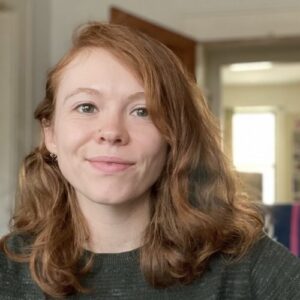
As a newly minted classics Ph.D., Rebecca Sausville was teaching at Brandeis University when she heard about the Civic Science Fellowship program. She immediately saw a connection with her academic research: In eastern Roman territories, when cities lost their traditional paths to glory, such as conquest, trade, and battlefield victories, they turned to intellectual achievement as a new source of civic pride. Knowledge became a form of civic engagement.
Fast forward two millennia, and Sausville recognized the same principle at stake. “I’ve long taken for granted the value of scientific inquiry for our lives and our well-being,” she says. But recent years revealed a gap. “Turns out, not everybody does.”
Scientists and scholars, she says, “just have to meet people where they are.” That’s what drew her to a Civic Science Fellowship at Princeton University to work on graduate student professional development through the GradFUTURES program in spring 2024.
Sausville had been hired to work on specific data projects exploring connections between graduate education and future employment. The GradFUTURES team, made up of five people offering comprehensive professional development to all of Princeton’s graduate students, needed help with many projects.
“I wore a lot of hats,” Sausville says, from helping facilitate events to reporting and writing for the GradFUTURES blog. “When I got into a communications beat, that was where I uncovered something that I hadn’t really expected,” she says.
While the data crunching was work geared toward changing the future, the comms work shined a light on what was changing now. “I found that the communications piece was what allowed me to directly promote civic science—the civic science initiatives that were happening on campus.”
Her supervisor, Eva Kubu, Princeton’s Director of Professional Development, helped her navigate the variety. “She’s really super inspiring as to what institutions can do by putting the needs of students first,” Sausville says.
Mining data for insight
Sausville worked on a wide range of tasks, including survey assessment, labor market analysis, and program evaluation. The goal was to recommend systems-level changes that could improve equitable access to opportunity for doctoral students at Princeton and beyond.
Her most significant project was somewhat archaeological in nature: excavating four years of unused survey data. Princeton collects questionnaires when students begin graduate school and when they finish, but no one had had time to thoroughly analyze them. “I made it a goal to produce a robust report about each of the surveys from the previous four years,” she says.
She cross-referenced the surveys with placement data from a company that tracks where alumni get jobs. Then came the detective work matching students to their GradFUTURES participation—experiential fellowships, learning cohorts, mentoring partnerships.
What she found was a surprisingly clear-cut correlation between students’ participation in multiple programs and where they landed after graduation. “Ninety-nine percent of them had employment one year out,” Sausville says.
It’s true that Princeton’s overall placement isn’t shabby—a Princeton Ph.D. carries weight. “But having that data to show is really compelling,” she says, especially when making the case for continued investment.
Even with numbers like these, changing the culture of academia takes time.But some changes may already be underway. The surveys revealed that students are increasingly open to non-tenure-track careers, particularly in sciences and engineering where “only a very small percentage highlight tenure-track positions as their end-all, be-all goal,” Sausville says. This speaks to the economic climate we’re in but also to the success that programs like GradFUTURES are having.
Sausville participated in some of the programming herself, to try to understand the student experience. She observed students having “light-bulb moments, discovering new possibilities, finding ways forward even in the academy’s current crisis of tight faculty hiring and shrinking research budgets.”
That shift, she says, is why these programs matter. Students need to see options beyond the single tenure-track path. But it’s also about civic science: preparing academically trained graduates to contribute to society in diverse ways, to make their knowledge accessible, to meet people where they are.
And students want this. In the program’s annual Lab Tales workshop, where STEM graduate students practice communicating their research through narrative, their reported confidence in presenting to broad audiences jumped from 25 percent to 87.5 percent. “They’re motivated to explain their scientific work in a way that’s accessible,” Sausville says. “They understand the need for accessibility in their work.”
Forging the future
But she’s also encountered resistance. Some advisors actively discourage students from participating in professional development. “I heard from individual students that they want to participate, but an advisor doesn’t want them to,” she says.
The problem is especially acute in lab sciences where students are often dependent on a single lab supervisor. If that advisor doesn’t offer professional development mentorship, students are not going to get it unless they seek it out on their own. This shows the importance of mentorship networks, Sausville says. Students need multiple mentors for different purposes—not one person to be everything, but a team.
In particular, many students could use more guidance on what some refer to as the “hidden curriculum.” This encompasses the unwritten rules about how to succeed that no one teaches you: things like networking at conferences, asking for mentorship, and how to dress and talk in professional settings. First-generation college students, women in STEM, and international students are most likely to miss the insider knowledge. Professional development programs help, but Sausville argues they’re not enough.
“The only way the playing field will be leveled is if this is a curricular requirement in graduate school,” she says. It could easily be included through monthly seminars and summer programming and integrated into existing courses. Without curricular requirements, students with supportive advisors get the benefits while others don’t even know the resources exist.
During the fellowship, Sausville herself benefited from a “team” of Civic Science Fellows with a wide variety of expertise. “It wasn’t just scientist and non-scientist” in terms of who had expertise, she says. “Some people were well-versed in some things and some people weren’t. You might be an expert in one thing, or a great number of things, but there’s always something to learn and something to improve.”
The variety is crucial to the future of civic science as a field, and as a career path. There’s no template for what a civic scientist looks like, Sausville says. “Lean into your differences. Those are actually a source of really important insight.”
Recognizing this aspect of civic science is critical for funders who want to have an impact. “Don’t have a very narrow idea of what you’re looking for in a fellow,” she says. “Like most things in life and in research, we benefit from diversity and from diverse perspectives.”
And the same is true for academia. Particularly at such a tumultuous time, work like Sausville’s that lights the way to a more equitable culture is urgent. The insights about what makes professional development more accessible—curricular integration, mentorship networks, making hidden knowledge explicit—can work anywhere.
The data she collected and the reports she wrote will inform future programs at Princeton, but the larger lesson is broadly applicable. Using evidence to push for structural change, ensuring everyone gets access to knowledge—not just the insiders who already know the hidden rules—can help forge a more inclusive path.
Rebecca is a member of the 2024-25 Civic Science Fellows cohort. Her fellowship was supported by the Princeton University Graduate School.