Words that Can Bridge Divides
January 16, 2026
How Julia Minson helps people disagree better
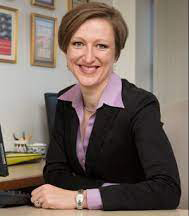
Ballroom dancing may seem an unlikely setting for lessons in psychology, but as a graduate student studying disagreement, Julia Minson drew on her experience as a dancer. In her teens and early 20s, Minson and her partner were among the top couples in competitive ballroom dancing in the United States. Practicing in rooms full of mirrors, they saw their performance from opposite vantage points, each with a better view of their partner’s mistakes. When something wasn’t going right in the dance, they frequently disagreed about who was to blame.
Working toward her Ph.D. in the lab of psychologist Lee Ross at Stanford University, she immediately saw a connection between dancing with a partner and what Ross called “naïve realism.” The idea is that most people believe that they see the world as it really is, so participants on both sides of an argument think they are the truly objective one, and it’s the other person who is misguided or simply lacks crucial information.
“I now notice this pattern a lot—in parenting, in work teams, in sports,” she says. “My work focuses on finding ways to help people understand conflict so they can be better at collaborating across differences.”
During her Civic Science Fellowship at Harvard’s Shorenstein Center working with director Nancy Gibbs, former editor-in-chief of Time magazine, Minson saw an opportunity to test her ideas on one of the most urgent conflicts of that time. “The pandemic had made everyone hyper-aware of how disagreement about science was literally killing people,” she says.
She focused on COVID-19 vaccine hesitancy. “It was this life-and-death problem that seemed very psychological,” she says. “A big part of the problem wasn’t about access to vaccines or cost. It was about trust, fear, and how we talk to each other about risk.”
She recruited vaccine-supportive people, trained them in a method she calls “conversational receptiveness,” and had them engage with vaccine-hesitant people through online messages and chat rooms. The results were striking. “When one side was trained, the other side saw them as more open, more trustworthy, and they wanted their advice more,” she says.
What made these conversations different? Two problems typically derail disagreements, Minson says. First, most people jump into “persuasion mode,” trying to win rather than connect. Second, even those who want to listen don’t know how to show it. Practicing conversational receptiveness addresses both issues with specific words and phrases that signal genuine engagement.
The language of receptiveness
Instead of trying to overwhelm someone with facts or logic, conversational receptiveness uses language that shows you’re engaging with the other person’s perspective.
“Imagine you’re talking with a vaccine-hesitant mother of a newborn,” Minson says. “Instead of saying ‘You’re wrong, vaccines are safe,’ you might say, ‘I understand that you have concerns about vaccines, and I know there’s been a lot of conflicting information out there that makes it really hard to know what to trust. And you want to do the best for your baby—of course you do. I agree that being a parent is a huge responsibility and we’re all trying to do the best we can with the information we have.’”
The approach follows what Minson has named the HEAR framework, which involves four strategies: Hedge your claims using words like “sometimes” and “possibly” instead of absolutes; Emphasize agreement with phrases like “we both want” or “I agree that”; Acknowledge the other person’s perspective by restating it, such as “I understand you’re saying that…”; Reframe contentious points toward the positive with phrases like “I would like to consider a policy…” instead of “I can’t support a policy…”
“It’s not saying ‘you do you,’ but recognizing your reasons are valid reasons, even if I disagree with your conclusion,” she says.
This might sound like common sense, but Minson has the data to prove most people don’t naturally do this—and that a bit of training makes a measurable difference. Her team used machine learning to analyze thousands of transcripts of people disagreeing, identifying patterns in the language of people who sounded the most receptive.
The team found that certain words consistently backfire: Negations like “no,” “won’t,” and “don’t” increase tension, and reasoning words like “because” and “therefore” can sound condescending when someone’s already defensive.
“When someone says, ‘I understand this is important to you’ or ‘possibly sometimes,’ that signals receptiveness,” Minson says. “But when they say, ‘You don’t understand because…’ that signals the opposite.”
Minson knows the method works, but using it takes practice, even for her. “I try very hard to use it all the time,” she says. “Sometimes I succeed and sometimes I fail.” As she’s shared in interviews, she regularly hears from her children that she’s not being receptive. “What I try hard to do when they call me on it is say, ‘I’m not listening, am I? I’m going to stop talking now.’”
This personal struggle has informed her interpretation of an unexpected finding from the vaccine study. Despite the improved trust and willingness to engage, the researchers were never able to document that conversational receptiveness persuaded more people to get vaccinated.
Rather than viewing this as failure, Minson reframes it as understanding how change actually happens. “Nobody’s casually vaccine-hesitant, so it’s not surprising that you’re not going to change minds by talking to a stranger on the internet for a few minutes,” she says. But if it means you want to talk to someone again, that increases the odds of a good conversation later, and perhaps, persuasion in the future.”
Minson channels these personal dynamics—and two decades of behavioral science research—into her forthcoming book How to Disagree Better (March 2026), which transforms her academic findings into practical tools for navigating conflict at home, work, and in our communities. Any conversation can be an opportunity to learn something new, build a relationship, or simply have a pleasant experience, she says. These are things that matter even when minds don’t immediately change.
Building a network for change
Being part of the Civic Science Fellows cohort revealed something crucial about scaling scientific insights into societal change. “It was interesting to see that all these different disciplines and different social problems had so much in common—the desire to improve society through science. And that to do that, it has to be collaborative,” Minson says. “You can’t solve civic problems from inside disciplinary silos.”
The community around the Fellowship is a large and growing network that includes the Fellows, their host institutions, and the nonprofits that support them. This creates a network effect that multiplies the impact of individual projects, she says. For instance, a researcher studying vaccine hesitancy can share methods with someone working on climate denial, while someone studying environmental policy can adapt tools from conflict resolution.
The Fellowship also allowed Minson to expand beyond one-on-one laboratory studies. Now she’s taking the work in multiple directions, including developing a curriculum to teach conversational receptiveness to high school students. “Imagine if teenagers learned how to disagree productively before they went to college or entered the workforce.”
She’s also working with executives through her company Disagreeing Better, addressing what she identifies as the root problem in many organizations: “Either you’re not speaking up out of fear, or you’re speaking up clumsily and blowing up the conversation.”
Even if just one of the people in a disagreement employs some of Minson’s strategies, the effect can be contagious. People tend to reciprocate receptiveness and sharing, she says, and this reciprocity makes the intervention scalable. You don’t need to train everyone, just enough people to shift the dynamic.
“If more people did this, we’d have a lot more conversations,” she says. “And we’d see that people are not as crazy as we thought they were.”
In an era when the average person would perhaps rather undergo dental work than have a 20-minute conversation with someone they strongly disagree with, that might be the most important finding of all: We don’t need to win these arguments. We just need to keep talking.
This is one lesson Minson has clearly succeeded in applying to her own life: That ballroom dance partner she used to disagree with in her 20s? He’s now her husband.
Minson is part of the 2021-23 Civic Science Fellows cohort. Her fellowship was supported by the Rita Allen Foundation and the Doris Duke Foundation.