Philanthropic Opportunities at the Intersection of Discovery, AI, and Democracy
June 4, 2026
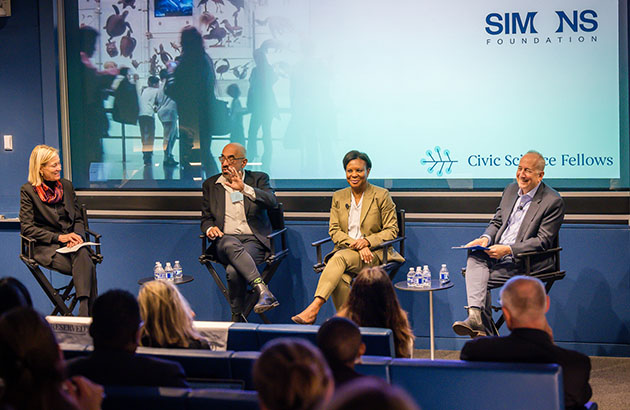
Civic science funders gathered at the Simons Foundation in New York City this spring to explore ways philanthropy can collaborate to support a future where all people can shape and benefit from science and technology. The gathering included a keynote conversation about the intersection of artificial intelligence, discovery science, and democratic governance with Simons President David Spergel and Alondra Nelson, Harold F. Linder Chair at the Institute for Advanced Study and architect of the Blueprint for an AI Bill of Rights. The conversation was co-moderated by Elizabeth Christopherson, President of the Rita Allen Foundation, and Eric Isaacs, President of the Research Corporation for Science Advancement and President-Elect of AAAS, who noted, “This is a real opportunity for us to reframe the way science and society interact.” The following insights are adapted from the conversation.
Reimagining the social contract for science
David Spergel: If we were to start science funding from scratch, what would we do differently? What are the structures? This is an exciting moment to be thinking about science policy because there may be a chance to reimagine some of these things. How can we get more return for society on our investments in science? It’s a moment where we are beginning to have deep conversations. We challenge everyone to think: In your ideal world, what would it look like? And could we get there?
Alondra Nelson: One of the big challenges that faces us right now is how do we include the public? The social contract for science exists in a larger social contract, which is our democratic commitments—the Constitution, the Bill of Rights, the rule of law. If we think about the science social contract as a kind of Russian nesting doll, as part of the other, then it requires us to ask hard questions about where the public sits. If you don’t have a public that’s been engaged, informed, and feels part of the conversation, it is only going to lead us to more contestation. I want us to have a more democratic process around how we think about our research ecosystem. There are quite a lot of ideas that we can bring to the table to build something that’s more fulsome and more democratic.
Civic science philanthropy in the age of AI
Alondra Nelson: I am a huge admirer of the civic science model because there’s space for different sectors to have cross-fertilization that’s really important. I’ve had the benefit of hosting Dr. Christine Custis as the first Civic Science Fellow at the Institute for Advanced Study. Christine is indicative of the kind of leadership we need. She has a career that goes from IBM to MITRE to the Partnership on AI as its first research director. In the humanities you might talk about “third culture kids.” Who are the third culture kids of science and society? We need colleagues and leaders who know how to think across different fields.
In the AI space, I am taking seriously the significant and growing negative public sentiment. Usually as a technology penetrates society, negative sentiment declines. In the case of AI, the negative sentiment is going up, and that’s astonishing. It’s bipartisan. It says to me that we have a problem, and it’s not just about communication, and it’s not only about trust. It’s going to require that we don’t just say, “AI is going to cure cancer.” We have to put on the table for people how that’s actually going to happen, and what it’s going to mean for their lives. We need people who know how to have that conversation, who know how to be in communities to have that conversation.
David Spergel: I’d echo the importance of bringing a broad set of talents to this conversation. If we want to rethink the relationship between science and society, we want to be bringing people in with perspectives from technology, from the humanities, from social science, lots of different players around the table. We come at this with different learned experiences.
When I look at AI and research, the questions I’ve been thinking about are what are the undervalued common goods? One of the roles of philanthropy is to support those. We’ve been worried about scientific code that’s being generated and used. There are people worried about AI taking over the world. I am more worried about AI increasing the level of mediocrity. The issues of how we incentivize, recognize, and control quality, and how we make sure that we’re not adding more bad data is an important issue and one that’s being undervalued at the moment.
The challenge with philanthropy, our advantage, is we have a long timescale. We should be thinking: Fifteen years from now, how does AI affect society and what investments do we need to make?
The opportunity of the moment
Alondra Nelson: The last few years have been quite disruptive and chaotic, but they’ve also been moments of awareness. We’re awakened to lots of things in the world and in society in ways that are really important. I don’t like the feeling that we live in a chaotic world, but I do see a lot of possibility. I see new coalitions of people, new conversations happening across sectors and across perspectives. That gives me a great deal of hope.
David Spergel: I’m going to build as a mathematical physicist on Alondra’s comment. The definition of chaos is that small changes make a big difference and that particles diverge. We’re at a moment where small changes, because things are changing so much, can have a significant impact. If we can have the vision to see what this small change might do to improve things, we have an opportunity to have a big effect.
Alondra Nelson is Harold F. Linder Professor at the Institute for Advanced Study, where she leads the Science, Technology, and Social Values Lab. David Spergel is President of the Simons Foundation. The 2025 Civic Science Funders Gathering was co-hosted by the Simons Foundation and the Civic Science Funders Collaborative.