Science Across Borders
October 9, 2026
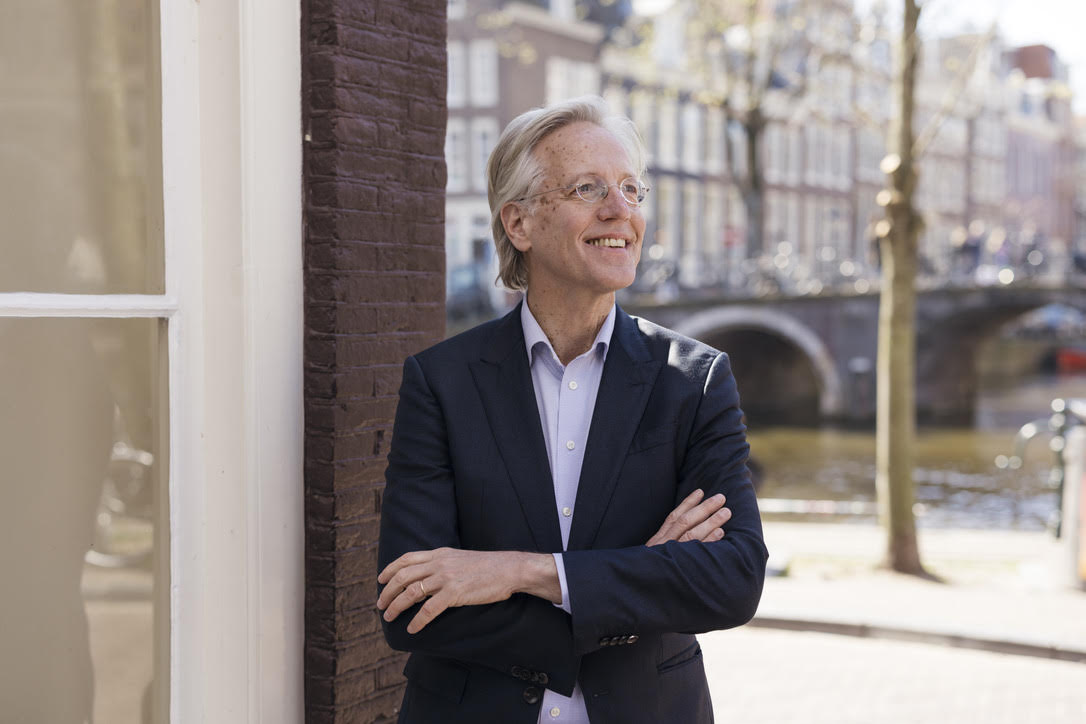
The 2026–28 cohort of Civic Science Fellows is supported by 49 host partner organizations working to change systems at the local, state, national, and international levels. We open this Civic Science Series with a conversation with Robbert Dijkgraaf, President-Elect of the International Science Council, one of the new host partners. Dijkgraaf, a mathematical physicist, former director of the Institute for Advanced Study, and former Minister of Education, Culture, and Science in the Netherlands, helped shape the Civic Science Fellows program as a member of the board of the Rita Allen Foundation. He sat down with new board member Ralph Izzo, a nuclear physicist who led New Jersey’s Public Service Enterprise Group and served as a science advisor to New Jersey Governor Thomas H. Kean. The following is adapted from their conversation.
Ralph Izzo: How has the ecosystem for scientific research changed over time, and how do you see it evolving now across continents?
Robbert Dijkgraaf: In some ways this is the best time to be a scientist—in terms of what we know, the technology, the global talent pool, the ways we are interconnected. As a government minister, I could see there’s not a single topic where science doesn’t play an important role, from health to agriculture to economics to social inequality.
But counterforces are pushing back against science, spreading misinformation, and looking at science through a very narrow lens of economic gain and national security, where international exchange is seen as a threat. The currents are the same in many places around the world. The impact of science is pushing against society, and parts of society are pushing back.
This is a wake-up moment for science. In some sense, science has to adapt to a different world. I feel actually it will come out better.
Ralph Izzo: How do the dynamics we’re seeing between science and civil society affect our ability to cooperate internationally, at a time of such tremendous opportunities and advances in science?
Robbert Dijkgraaf: Governments are becoming more interested in what scientists do when it comes to technology—AI, biotech, and quantum—but we are seeing rising barriers to international exchange, including rising visa restrictions, research-security measures that are sometimes too broadly drawn, and the undercutting of multilateral organizations.
Meanwhile, there are more arguments than ever for international cooperation in science. If you want to know where the next pandemic will come from or track severe climate effects, you better be aware of what’s happening in the rest of the world. You need the data. We also have huge basic research projects, which are too large for a single country to carry out. Basic science is a long-term investment and its returns cannot be captured by a single nation.
And we need more exchange about how we can better connect science to society. This whole agenda of civic science is something we should collaborate on. There are a lot of experiments being done around the world that we can learn from. We can bring these initiatives together.
Ralph Izzo: What is your advice for scientists who want to engage in this moment, particularly as AI is changing the landscape?
Robbert Dijkgraaf: The opportunities that AI presents for science are breathtaking. In whole areas of science that were just too complex to understand with our previous tools, we might find patterns. Yet our processes for regulating and thinking about it move on geological timescales compared to what’s happening.
For 10 years I lived in J. Robert Oppenheimer’s house at the Institute for Advanced Study. Many scientists are now in the position of nuclear physicists of his generation, particularly those working in AI. As scientists, we are in a privileged position to understand developments and be involved in how society thinks about it, how politics thinks about it, and help it be a force for good. Science doesn’t live in isolation. It is connected to the world. We have to connect to the world.
There are so many things you can do, and not everybody has to do everything. As scientists, we have the opportunity to do community outreach, to write pieces, to help build international relations, to inform our governments, to be advocates. But it could also be working in the local school. I’ve done a lot of public outreach, and it’s one of the most rewarding things I do. Science is a wonderful gift. There is an inner scientist in everybody, and it just has to be touched.
“What excites me most about this Fellowship is the opportunity to work at the point where research meets practice. The International Science Council brings together an extraordinary global community, and I’m looking forward to learning from its diversity of experience while contributing to how evidence can inform effective approaches to science communication. For me, that is the particularly exciting part of the Fellowship: not simply studying communication challenges, but working alongside scientists and institutional partners to develop and test approaches that can be useful in real-world policy and practice.”
—Khudejah Ali, 2026-28 International Science Council Civic Science Fellow