Shaping our Biotechnology Futures Amid Chaos
September 2, 2026
By Alicia L. Johnson
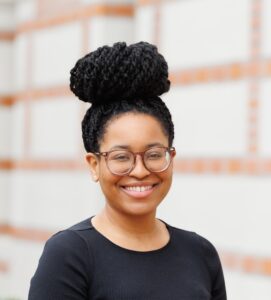
Synthetic biology, and biotechnology more broadly, have immense potential to provide solutions for environmental pollution, personalized medicine, and supply chain stability. Yet its rapid advancement requires us—researchers, knowledge workers, historians, ethicists, and local communities—to grapple with old and new questions about its societal and ethical implications.
My journey as a civic scientist began during my doctoral research in analytical biochemistry, which focused on developing precision medicine approaches to metabolism in epilepsy. Through this work, I became passionate about science communication, as well as ensuring that advancements in biotechnology are designed, accessible, and implemented in ways that are truly responsive to societal needs.
This passion led me to the Civic Science Fellows program, where I joined a community of people asking similar questions about how science connects with society, who gets to participate, and how trust is built.
As a Fellow, I began the work I continue today, studying the policy and societal dimensions of emerging biotechnology at Rice University’s Baker Institute. I work alongside an amazing interdisciplinary team of scientists and policy researchers developing microbes to detect viruses in wastewater. I also recently completed my time as a Biotechnology Regulatory Fellow at the National Academies of Science, Engineering, and Medicine, where I focused on the data governance and regulatory science infrastructures needed for environmental synthetic biology.
My work has highlighted regulatory gaps for environmental biotechnology, as well as how the existence of these gaps impedes the generation of critical data needed to address them.
In addition to regulatory issues, there are concerns of communities that will ultimately be affected by biotechnology. Communities near contaminated sites or agricultural sites—areas where environmental biotech could be most beneficial—are often systematically marginalized and have a history of negative health outcomes. Telling someone to “trust the science” is not that simple, especially when the systems that surround the science have harmed them.
Improving regulation is only one step toward ensuring that biotechnology is trustworthy, so my Fellowship project expanded to incorporate community engagement and ethics. Now, I am working to understand how the complex relationship between biotechnology regulatory policy, scientific research, and society informs the governance of emerging biotechnology.
The future of biotechnology faces serious challenges, including inequitable access, defunding and attacks on humanities and scientific research, regulatory uncertainty, and public distrust. This does not mean we should despair. Nor should we simply hope for a return to “normal.” The work required to repair the fragile relationship between science and society is more important than ever. Even if the path is uncertain, we must continue to move forward and recognize the opportunity to create something new.
In September, scientists including 2024 Nobel Laureate David Baker will gather with policymakers, ethicists, and community leaders at the Baker Institute for Synthetic Biology at the Intersection of Science, Ethics, and Policy. Together, we have an opportunity to chart a course for the responsible development of synthetic biology—one that is grounded in scientific rigor, social responsibility, and a commitment to the public good.
Infrastructure like the Civic Science Fellows program is crucial to providing the training needed to foster a new social contract between science and society, and I look forward to future generations of scientists gaining the skills to navigate the interplay of research, policy, and public engagement. As I reflect on my own journey, and the amazing people I have met along the way, I am filled with hope and determination. Together, we can build and steward scientific futures that are responsible, trustworthy, and accountable to the communities we serve.
Alicia L. Johnson, Ph.D., is a civic science postdoctoral associate at the Baker Institute Center for Health and Biosciences and the Science and Technology Policy Program.