Leading to Discovery: A Conversation between Francis Collins and Harvey Fineberg
January 16, 2026
Leading to Discovery: A Conversation between Francis Collins and Harvey Fineberg
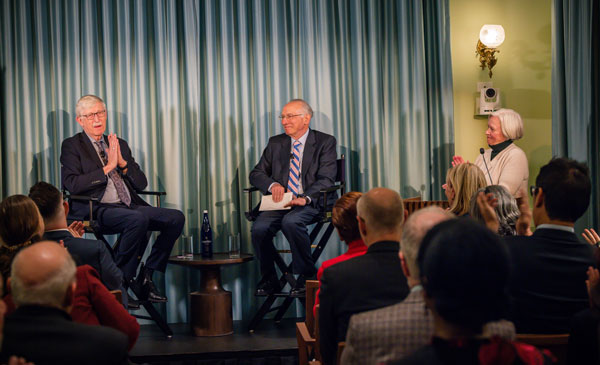
In December 2025, the Rita Allen Foundation hosted a fireside chat between Francis Collins and Harvey Fineberg to honor their legacies in civic science leadership and explore opportunities to build bridges in support of our scientific and civic future. We open the January issue of the Civic Science Series with insights adapted from their conversation.
Harvey Fineberg: You’ve witnessed many changes. Have you ever seen anything quite like this?
Francis Collins: The short answer is no. We have this amazing research ecosystem that has been so successful over decades, based on foundational research supported by taxpayers. The scientific opportunities right now are absolutely breathtaking. We are curing sickle cell disease. We are curing potentially a lot of other rare genetic diseases using gene editing. People with stage-four cancer who were putting their affairs in order are now finding they got into a clinical trial with an immunotherapy approach and they’re in remission and maybe they’re even cured. We are finally making progress on Alzheimer’s disease. This would be a terrible time to slow down. I can’t imagine a rational perspective that would say medical research should be scaled back. This is how we have been saving lives and we’re getting better at it all the time. But despite all that evidence, medical research in 2025 has been under severe stress from budget, grant, and staff cuts at NIH, and political attacks on research universities.
We will get through this. Our cause is compelling. I want to say to all the young scientists: this is the golden era for scientific opportunity. There’s never been a time like this to imagine solving mysteries, coming up with insights that are going to transform our ability to keep people healthy and to figure out how to manage disease when it happens. Our most significant resource is this next generation of talent.
Harvey Fineberg: What is a lesson you gained from leading the Human Genome Project that applies to any major scientific challenge today?
Francis Collins: The Human Genome Project was a real departure for life science. This notion that we would have to bring together what turned out to be 2,400 scientists to work together on a shared goal—that was radical. I learned early on to surround myself with people who were smarter than I was and who had a lot of specific expertise in areas that I did not have. Maybe the most important thing a leader can do is to make it clear to the people around you that you value their absolute honest input. Be sure the people around you are ready to tell you that you’re about to do something stupid, and also that you’re missing something really exciting that you haven’t noticed yet.
Harvey Fineberg: If you look back to your own life experience, what prepared you to be the leader of the Human Genome Project?
Francis Collins: I grew up on a farm in the Shenandoah Valley of Virginia. I didn’t go to school until the sixth grade. My mother was my main teacher, and she was quite gifted at that. We didn’t have any lesson plans that I could perceive. It was: What’s interesting today? Let’s talk about that. The main lesson I got was to love to learn new things.
That’s what the Genome Project was about. We were learning something astounding. Our own instruction book, our own code, and we had to invent all this technology to make it happen. Later, all the things I did as NIH Director were trying to tap into that same kind of boldness. What’s something new that we as a scientific community could learn that we haven’t learned yet? How do we collect the right critical mass to make that happen?
Harvey Fineberg: A topic that has always fascinated me about your work is how you combine commitments to religion and science. I’d love to hear you share how you reconcile seemingly irreconcilable beliefs. What might we learn in terms of bridging differences of understanding?
Francis Collins: When things appear to be irreconcilable, ask the question: Is that really the case? For me, science and faith coexist in a given afternoon in the laboratory, because the lab is discovering things about creation. Science is a way of getting a glimpse of God’s mind. Science is almost like worship. The lab is almost a cathedral. Science and faith ask and answer different questions, but both are ways of learning new things, pursuing knowledge, understanding why we’re all here, and taking advantage of the curiosity we’ve been given to discover things that are going to help people.
Speaking of the need for bridges, right now we seem to be at irreconcilable differences across the political spectrum. But they’re only irreconcilable because our society has decided that’s the way it has to be. So building bridges is something we’re all called to do. It requires a willingness to take a risk—to listen so carefully to the other person’s perspective that you truly understand their view, instead of planning your snappy response. We can’t expect our politicians to solve our divided situation right now. It’s up to us. We the people need to become those who are willing to build those bridges.
Francis Collins led the Human Genome Project and served as Director of the National Institutes of Health from 2009–21. He is Founder and Senior Fellow of BioLogos, and the author of The Road to Wisdom (Little, Brown, 2024). Harvey V. Fineberg served as President of the Gordon and Betty Moore Foundation from 2015–25, and previously as President of the Institute of Medicine, now the National Academy of Medicine.